And now, the page you've been waiting for...
The SALSIFY webpage
| Latin name
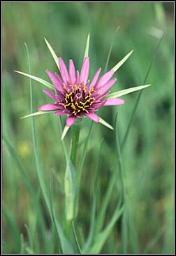
Tragopogon porrifolious, also known as The Oyster Plant. The 'y' in Salsify is pronounced as in
'empathy'.
I have written this page to make this
plant more widely known. It is easy to grow and it's
roots are delicious, tasting like artichokes.
The flower is shown here
(just incase you hadn't noticed) >
More details are given below.
|
 |
Contents:
History
Growing
Selection
Programme
Cooking
Nutrition
Back
to Home Page
History and
Background
Not much is
known about the origins of Salsify although it is a member of the
daisy family and is closely related to chicory, lettuce and
dandelion. It is very similar to the yellow - flowered
'Goatsbeard' or 'Jack-go-to Bed-at Noon'. The latter is called
this because its flowers tend to close at midday, a habit which
salsify also appears to have (which is why I rarely see them!).
It is believed
to have come from the Mediterranean area and occurs naturally in
dry grassy meadows. However, it can self-sow very easily in
British climates, as you will see in the 'selection' paragraphs.
Salsify is also
often compared with Scorzonera (pronounced Scorzo neera).
Although that plant is more productive and produces better roots,
in my opinion Salsify is much more delicious.
It is believed
to have been first cultivated in Italy in the early 16th century
(and in England in the late 17th).
As mentioned
before, salsify has a taste similar to Artichokes. Globe
Artichokes are very fiddly and take a long time to grow.
Jerusalem Artichoke tubers are easy to grow but are difficult to
obtain and expensive. In addition, storage of tubers could be a
problem if they cannot be left in the ground. NB/ all three
contain inulin, a sugar suitable for diabetics.
Back to
Contents
Growing Salsify
Salsify seed is
best sown around mid-April because it has a long growing season,
but as with most seed, does not like cold wet soil. The ideal
soil is sandy and fertile but not too rich. If the ground is
stony, clayey or over fertilised, the roots will fork.
The best variety in
my opinion is 'Giant'. The 'Mammoth' variety was not so
flavoursome, I seem to remember.
It can be planted
in blocks or rows with a minium planting distance of 6 inches. It
is best not transplanted because the roots can be rather
delicate.
Although
germination is about average, the plant grows slowly. At this
stage it weeding is important to avoid it being swamped by
similar looking grasses. In Autumn, it has a spurt of growth and
in late October and November the roots are ready for harvesting
(they look like thin cream coloured carrots).
When harvesting,
the roots must be handled carefully as they bleed (orange).
If the roots are
left in the ground, they should be covered with straw to protect
from frost.
Many books on the
subject say that if the roots are left till spring, the
subsequent shoots can be treated like asparagus.
Back to Contents
Selection
Programme
You will by now
have noticed my enthusiasm for Salsify. However, it does have
inherent characteristics which could be improved upon. If these
features could be improved by selective breeding à la Charles
Darwin, you would have a very popular vegetable.
These
characteristics are:
1) The roots tend
to fork more than other root vegetables (probably the worst
feature of this plant).
2) The roots tend
to go discoloured if not handled correctly.
3) The taste,
while delicious, is perhaps too subtle, especially in the larger
varieties
4) The roots are
relatively small if grown in normal British conditions.
5) They take so
long to grow.
Of course, it
would be difficult to select for all of these traits all at once,
so my first priorities are to a) generate a good seed stock and
b) reduce the forking problem.
My experiment
went as follows:
1992: Spring -
sowed seed from supplier. Autumn - selected roots which werent
forked and planted them again.
1993: Summer -
plants flowered, collected seed (seed heads are like giant
dandelions). Collected seed were much larger than original ones.
1994: Sowed
collected seed - found that they germinated much better than
supplier's seed. Autumn: got married (not to Salsify!) End of
experiment.
1995 to 98:
Salsify continue to self-sow. Seed normally viable for two years.
2000 Spring: New
programme begins with self sown seed and supplier seed again. Vow
not to get married again...
2000 Autumn: Despite a very wet year, all salsify
and artichokes grew well. Unfortunately, the salsify roots were very forked
( I didn't follow my own advice) and even worse, did not cook as well as the
Jerusalem Artichokes (which were far more productive, less tough and more tasty...
I know - sacrilege!!). However, next year's salsify roots have been selected
and replanted. The Globe Artichokes, which weren't supposed to flower in their
first year, did flower... and continued to do so despite me taking off the flowerheads.
2001 Spring: Planted roots sprouted quickly, but
not as well as the others I left in the soil. I left them there so that I could
try the 'asparagus-like' shoots which 'grow in spring'. Well, I tried them,
but can only say that they more closely resembled shoelaces than asparagus,
or indeed, any other specimen in the plant kingdom.
2001 Summer: All the plants grew and flowered. I noticed that,
like several other members of the Dandelion family, it had a suppressent effect
on couch grass. The flowers were very pretty, and I did take photos, but they
seem to be hiding somewhere.
2001 Late Summer: Got a massive harvest of seeds from the selected
roots, but by this time, the allotment was getting a bit too much for me, so
I had to give it up again. If anyone wants several hundred seeds, let me know!
End of story.
Back to Contents
Cooking
The roots must
first be thoroughly cleaned, which may be difficult due to the
roots forking. There is no point trying to peel at this stage -
that job is much easier after boiling, when the skin can be
rubbed off.
I have tried
various methods of cooking, but by far the best is to boil the
roots in salted water for at least 20 minutes. The water must
have a squirt of lemon juice to stop the roots going black
The salsify can
then be served simply with a knob of butter. It is best eaten as
a delicacy
Some recommend
sautéing in butter, but that tends to harden its texture. Others suggest grating raw salsify - sounds
unpalatable to me, but I'll have a go sometime. Salsify is so
productive that there is often a surplus. Try making it into
soup.
The 'asparagus' type flowering shoots which pop up in
spring are recoomended in gardening
books, but I've tried that. Although there are similarities with
asparagus, they do not have the same flavour, and I found the
outer leaves and base unedible (after 15 minutes boiling).
Back to Contents
Nutrition
According to the University of California, one
'cup' of cooked salsify (as opposed to a 'bowl' or a 'frying
pan') has the following nutrional values:
40 calories, 3.5g of protein, 3.8g of fibre,
20.4g of carbohydrate
60mg calcium, 19mg magnesium, 1.7mg iron, 251mg potassium
very little vitamins A, B, C or E
Nutritionally, it is likened to parsnips except that it has
slightly more protein and only half the calories.
Back to Contents